

How to Create a Mind Map for Small Business Marketing Strategies
Marketing can feel like the most overwhelming part of running a small business. Between social media, email campaigns, SEO, paid ads, and old-fashioned word of mouth, it's easy to end up with a dozen half-finished ideas and no clear plan. That's exactly the problem a mind map is built to solve.
A mind map is a visual thinking tool that starts with one central idea and branches outward into related topics, tasks, and details. For small business owners juggling limited time and budget, mind mapping turns a tangled list of marketing ideas into a clear, organized picture — one that shows how every piece connects to the bigger goal. Instead of staring at a blank page trying to write a marketing plan from scratch, you start by simply capturing what's already in your head and then organizing it visually.
In this guide, we'll walk through exactly how to build a mind map for your marketing strategies, show you a real example, and explain how to turn that map into an action plan you can actually execute.
Why Small Businesses Benefit from Mind Mapping
Traditional marketing plans are often written as long documents — dense, linear, and easy to abandon after the first draft. A mind map works differently. Because it's visual and non-linear, it mirrors how ideas actually form in your head: a central goal with strategies branching off in multiple directions at once.
For a small business, this matters for a few practical reasons:
It shows the whole picture at a glance. You can see every marketing channel — content, social, SEO, email, paid ads, community outreach — on one page, instead of scattered across notebooks and sticky notes.
It reveals gaps and overlaps. If one branch (say, social media) is packed with ideas while another (like email marketing) is empty, that imbalance jumps out immediately.
It keeps strategy and tactics connected. Every specific tactic traces back to a branch, and every branch traces back to the central goal, so nothing feels disconnected from the bigger picture.
It's fast to build and easy to update. A mind map can be sketched in fifteen minutes and revised in five, which matters when you're wearing ten hats and don't have time for a 20-page strategy document.
Step 1: Define Your Central Idea
Every mind map starts with a single node in the center of the page. For a small business owner, this should be your core marketing objective — not a vague idea like "get more customers," but something specific enough to guide decisions. Examples include "Grow local brand awareness in the next two quarters" or "Build a repeatable lead pipeline for our service business."
Write that objective in the center of your page or digital canvas. Everything else in your mind map will branch outward from this single point.

Step 2: Add Your Main Branches
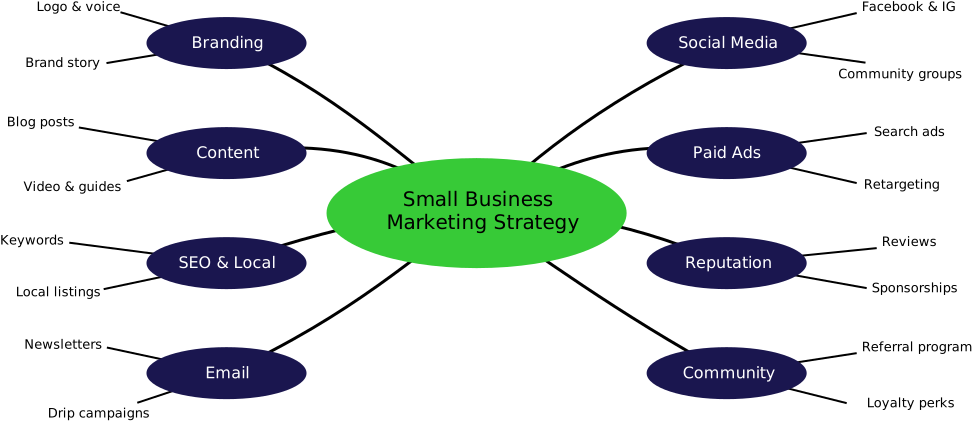
From the central idea, draw branches for each major category of your marketing efforts. Most small businesses find that six to eight main branches cover the essentials:
Branding — logo, voice, visual identity, brand story
Content — blog posts, videos, guides, case studies
SEO & Local Search — keywords, Google Business Profile, local listings
Email Marketing — newsletters, drip campaigns, promotions
Social Media — platform strategy, posting cadence, community groups
Paid Advertising — search ads, retargeting, social ads
Reputation & Reviews — review generation, testimonials, referrals
Community & Sponsorships — local events, partnerships, loyalty programs
You don't need every branch — pick the ones that actually apply to your business model. A local service company will lean heavily on reviews and local SEO, while an e-commerce brand may lean into paid ads and content.
Here's what that structure looks like in practice:
Step 3: Expand Each Branch with Sub-Branches
This is where the mind map earns its keep. Under each main branch, add smaller sub-branches with specific, actionable ideas. Under "Content," for example, you might add "weekly blog post," "monthly case study," and "how-to video series." Under "SEO & Local," you might add "target keywords," "update Google Business Profile," and "build citations on local directories."
The goal at this stage isn't to filter or judge ideas; it's to get everything out of your head and onto the page. You can prune later. The more specific each sub-branch is, the easier it becomes to hand off to a team member or turn into a task on your calendar.
Step 4: Prioritize and Assign Resources
Once your mind map is full, step back and evaluate it with a critical eye. Not every branch deserves equal investment, especially for a small business operating with a limited marketing budget and a small team. Ask yourself:
Which branches align most directly with your central objective?
Which tactics can you realistically execute with your current time, budget, and staff?
Which ideas require outside expertise or tools you don't currently have?
Color-code or star the sub-branches that matter most right now, and gray out the ones that can wait for a future quarter. This step turns your mind map from a brainstorm into a filtered, realistic plan.
Step 5: Turn the Mind Map into an Action Plan
A mind map is a planning tool, not a task list, so the final step is translating it into action. Take your prioritized branches and convert them into a simple calendar or project board: what happens this month, who owns it, and what "done" looks like. Many small business owners find it useful to revisit the mind map quarterly, updating branches as new marketing strategies emerge or old tactics get retired.
Here's the full process from blank page to execution:

Tools for Building Your Mind Map
You don't need fancy software to get started — pen and paper work fine for a first draft. When you're ready to make it shareable and easy to update, digital mind mapping tools (or even a simple slide or whiteboard app) let you drag branches around, add color coding, and share the map with your team. What matters far more than the tool is the habit: revisiting and refining your map as your business and your marketing strategies evolve.
Turning Your Mind Map Into Real Results
A mind map gets your marketing strategy out of your head and onto the page — but turning that map into consistent execution, measurable results, and a steady stream of leads is where many small business owners run out of time, tools, or expertise. That's where Muraico comes in.
Muraico helps small businesses take the ideas mapped out in a strategy session and turn them into working marketing systems — from optimizing your scheduling system with an AI agent to review generation, email automation, and lead nurture workflows. Instead of juggling every branch of your mind map alone, you get a partner who can help prioritize, build, and manage the pieces that will move the needle fastest for your business.
Ready to turn your marketing mind map into a real strategy? Contact Muraico today to see how we can help you achieve your small business marketing goals.