
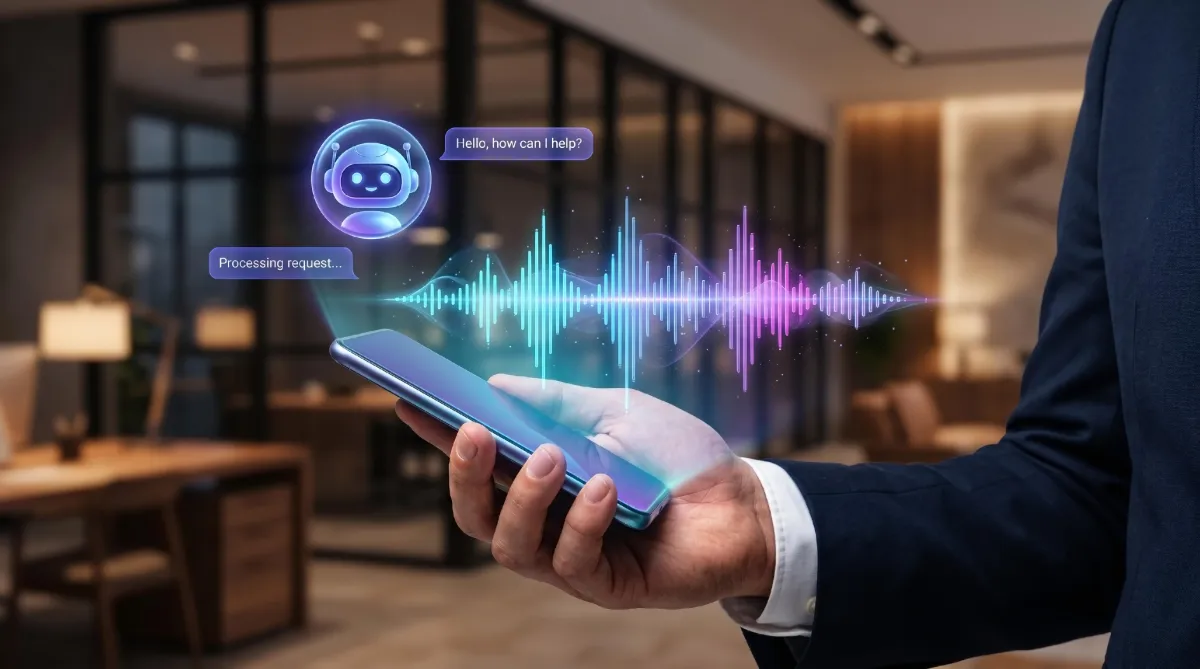
What is voice AI technology?
What Is Voice AI Technology?
Not long ago, talking to a computer meant yelling "REPRESENTATIVE" at a phone tree menu until it gave up on you out of pity or you simply slammed down the phone out of frustration when you had to Press Zero to return to the main menu - again!
Voice AI is the reason that's finally starting to change, and no, "press 1 for English" doesn't count as AI, no matter how confident it sounds.
Here's what voice AI actually is, why it's showing up in more places than just your phone's assistant, and what to look for when you are considering switching to the new norm.

The basic idea
Voice AI technology is technology that can understand spoken language, figure out what someone means, and respond, either by responding or by taking action. It's often grouped under the broader umbrella of conversational AI, since the goal is a back-and-forth exchange, not a one-way command. Under the hood, it's usually a combination of a few things working together:
Speech-to-text: turning spoken words into text the system can actually process, powered by what's often called voice recognition technology
Natural language understanding: figuring out the intent behind spoken words using natural language processing (NLP). Not just the words themselves, since "can you cancel my order" and "I need to cancel my order" mean the same thing to a person but look pretty different on paper.
A response engine: deciding what to say or do next
Text-to-speech: turning the response back into something that sounds like a voice and not a dial-up modem
Put those pieces together well, and you get something that can hold an actual conversation instead of forcing you to speak in keyword-flavored robot dialect.
Where it shows up
Voice AI has quietly worked its way into more of daily life than most people realize:
Virtual assistants: the ones on phones and smart speakers. Handling reminders, questions, and smart-home commands
Customer service: AI voice bots that can actually resolve simple requests instead of just reading a menu at you in a soothing tone
Accessibility tools: voice control and dictation for people who can't easily use a keyboard or screen
In-car systems: hands-free navigation and controls, which is really just voice AI's way of making sure you never learn what half the buttons in your car do
Meeting and call tools: transcription, note-taking, and summarization, so nobody has to be "the person who takes notes" ever again
These voice assistants and voice-driven tools are becoming so normal that most people don't even register them as AI anymore, they just expect a device to understand what they say.
Why it's gotten so much better, so fast
Older voice systems had a well-earned reputation for being frustrating: rigid scripts, narrow vocabularies, and an uncanny ability to mishear "yes" as literally anything else. Newer voice AI, built on more advanced language models, understands context, handles natural phrasing, and can follow a conversation instead of resetting every time someone goes slightly off-script.
The practical result: voice AI has gone from "technically works, if you speak very slowly and clearly like you're talking to a toddler" to "can actually understand a normal sentence," which turns out to matter a lot for whether people trust it enough to use it for anything important.
What makes it useful for businesses
Beyond the novelty, voice AI solves a real operational problem: a lot of work still happens over the phone, and a lot of that phone work is repetitive, answering the same questions, collecting the same information, routing the same types of calls. Voice AI can handle a meaningful chunk of that volume without a person needing to be on every single call, freeing people up for the conversations that actually need a human: the tricky ones, the upset customers, the judgment calls no script can cover.
The honest limitations
Voice AI isn't magic, and it isn't a replacement for every human conversation. It still struggles with heavy accents in some systems, background noise, and genuinely ambiguous requests where even a person would need to ask a follow-up question. It's best treated as a tool for handling volume and routine, not as a stand-in for every interaction a business has.
The bottom line
Voice AI is, at its core, just teaching a computer to have a conversation instead of following a script. It's not perfect, and it's not going to replace every human on the other end of a phone line, but for the repetitive, predictable stuff, it's quickly becoming good enough that "talking to a computer" doesn't automatically mean frustration anymore. Which, given the history of phone menus, is genuinely an accomplishment.
The Muraico Difference
Voice AI handles the volume of incoming calls. It works 24/7 and never calls in sick. But there is so much more. Muraico has the operational experience to look beyond the obvious. If you are an employer, you would want your receptionist to be able to do more when not busy. If you are the receptionist, very likely you want to grow with the company, and be able to do more as well. With our operational background, we ask the follow-up questions to complete the process. For instance:
what happens to the contact data
how does the caller feel when they hang up
how do you know when the call is urgent
who owns the follow up